
Good decisions begin by separating what is known from what is merely assumed.
Fortunes Visualized combines long-term thinking, transparent assumptions, and visible decision models so the audience can inspect the reasoning, not merely receive a verdict.
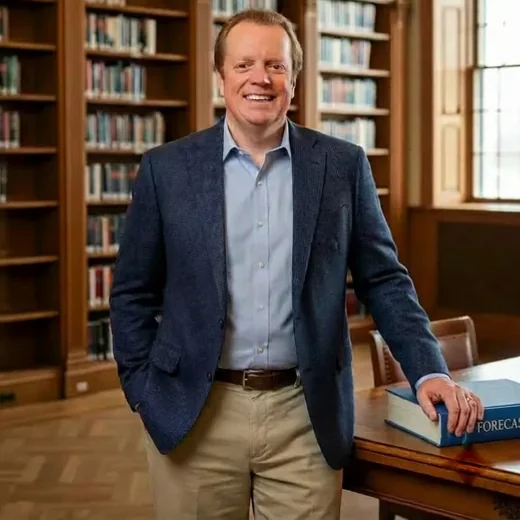
Founder and host
Thirty-plus years turning difficult questions into decisions people can act on.
Stephen built Netflix’s first business data science team and was Tableau’s first director of analytics.
He has worked across analytics, forecasting, data science, decision systems, and executive education. Fortunes Visualized brings that experience to education, housing, debt, careers, retirement, family, and business decisions.
“I love helping people see new ways to improve their lives, especially by thinking long-term, questioning assumptions, and grounding important decisions in data.”
The authority is specific and independently testable.
The site should not ask visitors to trust generic expertise language. These are the facts most relevant to the work.
- Netflix
- Built the company’s first business data science team and developed subscriber lifetime-value and retention frameworks used across marketing, operations, and finance.
- Tableau
- Served as Tableau’s first director of analytics, helped create its original authorized training program, and wrote the first dedicated Tableau book.
- Decision systems
- Led work spanning SAS, Oracle, Yahoo, Navy Cyber, governed AI systems, national-scale forecasting, and a simulation engine supporting a $1B-plus pharmaceutical acquisition.
- Independent proof
- Tableau co-founder and Turing Award laureate Pat Hanrahan built part of his 2012 Tableau Conference keynote around The Accidental Analyst and its analytical framework.
Useful simplification, with the uncertainty left visible.
Real financial lives are complicated. A useful model simplifies reality while identifying what was observed, estimated, adjusted, excluded, or left unknown.
- 01
Separate facts from assumptions
Label observed facts, estimates, user inputs, and missing information differently.
- 02
Construct more than one future
Compare baseline, conservative, and upside cases instead of presenting one forecast as certainty.
- 03
Rank the assumptions
Stress inputs consistently so the controlling variable reflects analytical impact rather than arbitrary test sizes.
- 04
Calculate the flip point
Find the exact threshold where the preferred choice changes.
- 05
State the reversal condition
Explain what new evidence would make the current verdict wrong.
- 06
Commit under stated assumptions
Give a clear verdict without disguising uncertainty as precision.
The goal is clearer thinking, not perfect prediction.
Sources and material assumptions are identified whenever practical. Public information can still be incomplete, outdated, estimated, or incorrect.
Models may omit taxes, fees, inflation, transaction costs, changing interest rates, market volatility, personal circumstances, and unexpected events unless those factors are specifically included.
Reaction and commentary models are educational approximations, not forensic reconstructions of another person’s finances. Assumptions may be adjusted to create a representative scenario.
Read the full Financial Disclaimer →